Patina and reaction
Different chemical solutions directly alter the brass plate, generating colours, densities and textures without recourse to pigment. Matter does not act as a support: it produces the image.
2012–present · Ongoing process
Territorios de lo olvidado takes matter as a repository of memory. Brass, patina and oxidation construct surfaces that seem to contain an earlier time: fragments, traces and accidents that oscillate between landscape and vestige.
The pieces develop between control and transformation. Some function as ensembles while retaining their individual autonomy. The surface changes with the light and incorporates the viewer’s presence through reflection.
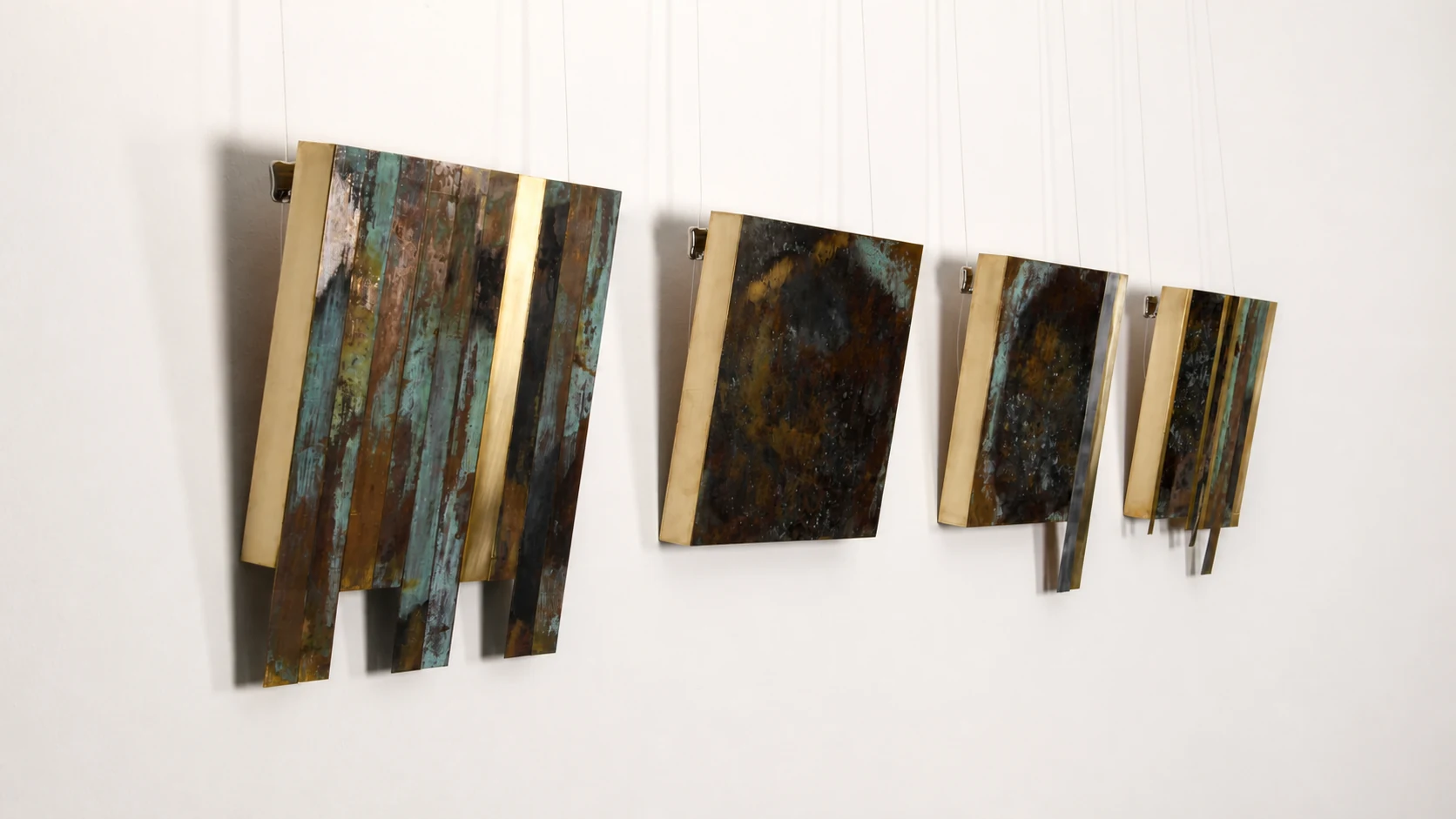
Territorios de lo olvidado I — ensemble of four piecesInstallation view at Incubarte VI — International Independent Art Festival · Jardí Botànic de la Universitat de València · Valencia, 2013
Individual works · 2012
Process and installation
In Territorios de lo olvidado, the image is not deposited on the surface through pigments; it emerges from the transformation of the brass itself. Chemical action, abrasion, light and the viewer’s presence turn matter into an active, variable and perceptual field.
Different chemical solutions directly alter the brass plate, generating colours, densities and textures without recourse to pigment. Matter does not act as a support: it produces the image.
Sanding removes material, opens lines and modifies the degree of reflection. The incisions construct a changing surface whose perception depends on distance, movement and point of view.
The polished brass edges and the pieces projecting from the plane capture the light, cast a golden glow and throw shadows onto the wall. The work thus extends into the space that contains it.
The metal’s reflective capacity incorporates an unstable image of whoever approaches it. The viewer no longer remains in front of the work but appears, fleetingly, within it.